In this post I will present some thoughts I've been having recently around value. In particular I will propose that the value theory presented by Marx in Capital might actually be a marginalist theory. Not marginal in the sense of the subjectivist theory of the bourgeouis economists, but marginal with respect to labour.
I've been tinkering with this text since 2025-11-12. I had initially in mind to release it before the end of 2025, but found that I had to read a lot more of the literature before doing so. This text is also the longest text on the blog so far, surpassing the previous record set by the post In-kind accounting.
I would like to thank the following people for providing feedback on draft versions of the text:
- Dave Zachariah
- Leone Castar
- Toasted Bread
- Alexander Creiner
In this text the word "labour" is short for social labour. The word Capital refers both to Karl Marx' books (volumes I-III) and is also the proper noun for Capital-the-god, the emergent will of the market, the undead monster ruling unthinkingly over workers and bourgeoisie alike. I will sometimes use the word "time" as shorthand for "person-time", such as worker-hours.
For most of the text I assume the technical makeup of the economy is fixed.
Mass values
In volume I of Capital, Marx talks about how the value of a commodity is the sum of the direct and indirect labour that goes into making that commodity. A certain quantum of labour is "embodied" in a commodity, Marx says. For example, the value of steel is the value of the iron ore and coke that goes into making that steel, plus the new value added by the direct labour in the steelmaking process. The value of ore and coke can be similarly broken up into the value of their constituent parts plus the new labour added. We can also go the other way by adding up value at each stage in the production process. This can be expressed in vector form. In the first "stage" we have the following:
where is the row vector of values computed so far, is the vector of direct labour inputs. is the matrix of technical coefficients, which expresses columnwise how much input is required to produce one unit of output. The technical coefficients represent the "average" way of producing any particular commodity. If we pretend that none of the inputs require any inputs in turn, then it should not be difficult for the reader to convince themselves that indeed expresses the value of each of those inputs. contains how much labour is added per unit of each commodity, and each column of how many units of input is required for each unit of output. Therefore expresses how much labour is added indirectly via the inputs.
In reality ore and coke also require certain inputs to produce. To account for the inputs' inputs we must perform another "stage" of summing up, which will give us the following:
If we continue this process indefinitely then we will arrive at vol I values:
The last step uses the von Neumann series and should be familiar to some readers. In On vertical integration I call it the "left" Leontief inverse.
Here contains the whole mass of labour added per commodity, the term "mass" being used in the same sense as Marx uses it, namely the total amount of social labour used in the production of each commodity. Similarly we can speak of the mass of commodities, which is also just the total (gross) amount. The value of each commodity is the mass of labour divided by the mass of commodities. I will therefore call these kinds of vertically integrated values "mass values".
Let us look at an example. Suppose society produces coke, ore, steel and cars. The dimensions of coke, ore and steel is mass. Cars are produced in countable dimensionless units. 4, 2, 10 and 40 hours are spent producing 8 tons of coke, 2 tons of ore, 1 ton of steel and 2 cars respectively. The mass values of each of the four commodities are then:
- Coke: 4 hours / 8 tons = ½ hours/ton
- Ore: 2 hours / 2 tons = 1 hour/ton
- Steel: 10 hours / 1 ton = 10 hours/ton
- Cars: 40 hours / 2 unit = 20 hours/unit
Mathematically we have
where the two divisions are per-element.
Marginal values
In vol III of Capital, Marx follows Ricardo in describing how ground rent works. Ground rent is a marginal effect that is determined by the worst production method currently in use rather than some "average" production method as in vol I. For example, if Alice and Bob both grow potatoes, and Alice takes one hour to grow one ton of potatoes while Bob takes two hours to grow one ton of potatoes, and Alice and Bob can grow at most one ton of potatoes each, then the following holds:
- If the demand for potatoes is between 0 and 1 ton, then the value of potatoes is 1 hour/ton (Alice's productivity). Bob's fields are not brought into use
- If the demand for potatoes is between 1 and 2 tons, then the value of potatoes is 2 hours/ton (Bob's productivity). Both fields are brought into use
The figure below illustrates the situation.
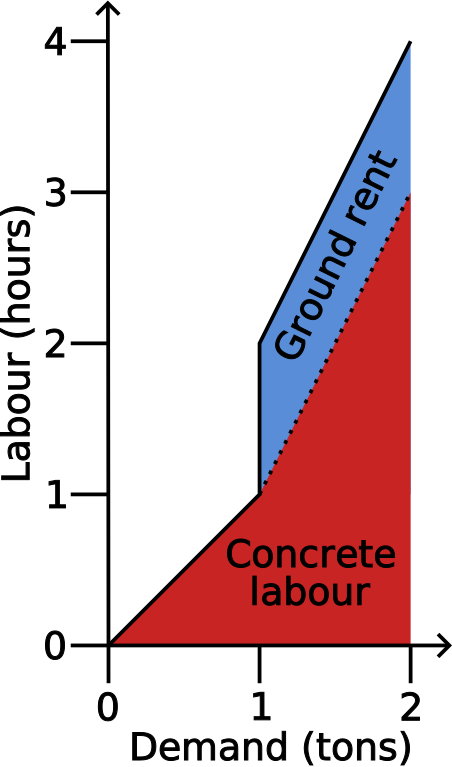
If the demand for potatoes is 2 tons then Alice and Bob must put in 3 hours of labour. This is the concrete labour shaded red in the figure. The value of potatoes is 2 hours/ton and the total amount of value produced is 2*2 = 4 hours. The difference between the 3 hours of labour and the 4 hours of value is pocketed by Alice as ground rent. In the extreme, Alice can realize ground rent the moment the demand for potatoes is one molecule of starch above 1 ton. This is shown in the blue area in the figure, with a corresponding immediate jump in ground rent. There are no "averages" to speak of as far as ground rent is concerned. Ground rent is marginal.
The marginal effect demonstrated above is not limited to agriculture. The equivalent effect in industry Marx calls "extra profit", also known as "superprofit". Superprofits are realized by those capitalists who use the most efficient means of production. More specifically, by those capitalists who best economize on social (not concrete) labour. Concrete labour is the actual labour performed by each worker. Capital doesn't mind wasting concrete labour so long as it is cheap.
Marx claims that superprofits are realized with respect to the "average" level of productivity in each industry. Marx is not clear what he means by "average", because in some places he actually means the worst production method. The following paragraph, quoted by Novozhilov (whom we will return to), supports this:
differential rent [...] is nothing other than additional profit existing in any sphere of industrial production for any capital functioning in better than average conditions. Only in agriculture is it consolidated, since it rests on such a solid and (relatively) stable basis as different degrees of natural fertility of different categories of land.
Here we have another annoying case of Marx being careless with his language. I have touched upon a similar case where Marx confuses ratios for derivatives. See the post On Marxian notation.
Getting back to the quote, Marx says average, but surely means worst, because in vol III, when describing how differential rent comes to be, he again and again says, with examples, that it is realized with respect to the worst land, not some "average" land. Therefore I will take what Marx actually means is that superprofits are realized with respect to the worst industrial processes currently in use. This makes ground rent and superprofit the same thing, which is very pleasing and mathematically convenient. There is no reason to assume that industry and agriculture are fundamentally different. Both produce commodities using scarce means of production, including labour power.
We can now notice that in Capital there are two mutually exclusive value theories at play, which I will call the mass labour theory of value and the marginal labour theory of value. At most one of these theories can be correct. It is not possible for both to be correct, because value cannot be determined both by an average production method and by the worst production method at the same time. The two theories are equivalent in one and only one case: when for all commodities the worst production method is also the average production method. This implies uniformity in production methods for all commodities. I will come back to this point.
We could also take Marx at his word and consider there to be three value theories in Capital. The two theories mentioned above, plus a third one where ground rent/superprofit is realized with respect to the average production method, not the worst. We will soon see that any theory based on averages is unworkable, so such a theory must be false.
Joint production
One limitation with the mass labour theory of value, and with what Marx says in all three volumes of Capital, is that it assumes that each production process outputs exactly one commodity, an assumption that I will call simple production. As a consequence there is only one way to distribute the value of the inputs, plus the new value, over the one output. There are no degrees of freedom. If however there's two or more outputs, a case known as joint production, then Marx has nothing to say about how the total value is to be distributed over them. In each production process, the number of degrees of freedom is equal to the number of outputs minus one. We must somehow come up with numbers for those missing data points. In statistics the act of inventing data is called imputation. For this reason the problem of computing joint labour values is also known as the imputation problem.
Let us consider a stamping process that takes sheet steel and labour as inputs and produces cutlery and scrap steel as outputs. Neither output can be considered worthless because cutlery is the primary product and because there exists a market for scrap. How is the value put in (constant and variable capital) to be distributed across the two outputs? If we for the moment assume that there is only one production process for cutlery + scrap, and we assume that there are no marginal effects, and no depreciation of machinery, then we have the following:
We could choose any numbers for and so long as their sum is equal to . Why is this important? It is important because Marx sought to provide an objective, descriptive model of why any given price vector is what it is. The vector around which said price vector fluctuates is the value vector, the "center of gravity" towards which prices converge. Unfortunately, as soon as degrees of freedom are introduced into the system, this model is no longer objective. In the example above, what exactly determines how much cutlery and scrap are worth respectively? All that we know is that their joint value should equal the value of the steel plus the new labour added.
We could set the degrees of freedom such that the resulting value vector closely mimics the observed price vector, but then we are "explaining prices using prices" as Marx puts it.
The ultimate point that I will get to is that labour minimization is what acts as the "tie breaker" in joint production. Before we can get there, we must deal with another theoretical complication: non-positive values.
Non-positive values
In the cutlery-scrap equation, all that we demand is that the sum of the value of cutlery and scrap must equal the value of steel plus the new labour added. Nothing at all prevents us from considering either product to be worthless (zero value), nor the possibility of negative values, or even complex values. Let us for now pretend that time doesn't exist, so the possibility of complex values (value phasors) does not have to be considered.
The possibility of zero values is presented by Marx himself in the opening paragraphs of vol I of Capital. Marxists are well aware of this supposed "deboonk" of the labour theory of value (LTV), commonly called the "mud pie argument". That is, the notion that something has value just because labour has been expended in its production, such as making pies out of mud that nobody wants, or digging a hole only to fill it up again. Marx eviscerates this argument in chapter 1 of vol I:
Some people might think that if the value of a commodity is determined by the quantity of labour spent on it, the more idle and unskilful the labourer, the more valuable would his commodity be, because more time would be required in its production. The labour, however, that forms the substance of value, is homogeneous human labour, expenditure of one uniform labour power. The total labour power of society, which is embodied in the sum total of the values of all commodities produced by that society, counts here as one homogeneous mass of human labour power, composed though it be of innumerable individual units. Each of these units is the same as any other, so far as it has the character of the average labour power of society, and takes effect as such; that is, so far as it requires for producing a commodity, no more time than is needed on an average, no more than is socially necessary. The labour time socially necessary is that required to produce an article under the normal conditions of production, and with the average degree of skill and intensity prevalent at the time. The introduction of power-looms into England probably reduced by one-half the labour required to weave a given quantity of yarn into cloth. The hand-loom weavers, as a matter of fact, continued to require the same time as before; but for all that, the product of one hour of their labour represented after the change only half an hour’s social labour, and consequently fell to one-half its former value.
And a bit further down:
A thing can be a use value, without having value. This is the case whenever its utility to man is not due to labour. Such are air, virgin soil, natural meadows, &c. A thing can be useful, and the product of human labour, without being a commodity. Whoever directly satisfies his wants with the produce of his own labour, creates, indeed, use values, but not commodities. In order to produce the latter, he must not only produce use values, but use values for others, social use values. (And not only for others, without more. The mediaeval peasant produced quit-rent-corn for his feudal lord and tithe-corn for his parson. But neither the quit-rent-corn nor the tithe-corn became commodities by reason of the fact that they had been produced for others. To become a commodity a product must be transferred to another, whom it will serve as a use value, by means of an exchange.) Lastly nothing can have value, without being an object of utility. If the thing is useless, so is the labour contained in it; the labour does not count as labour, and therefore creates no value.
Some important observations are made here. A product can have a value of zero. That is, a thing can be worthless. Such a worthless thing is, to Marx, categorically not a commodity. For the sake of argument I will reject this categorization, since it is overly restrictive. It is also not in line with reality, since some commodities do indeed trade at a price of zero, or even at negative prices. One example of this is spot prices for electricity. Other examples include industrial waste, sewage and so on. The introduction of cap-and-trade schemes for greenhouse gas emissions represent an attempt at imposing negative prices by writ. If prices can be zero or even negative then there is no reason to assume values cannot also be zero or negative. We are forced by empirical observations to entertain the notion of non-positive values.
Note that it makes no difference if one tries to get away from negative values by instead positing that such outputs are instead negative inputs with positive value. That is, that capitalists paying to get rid of waste is really to be seen as just another input that is paid for, just that it goes the other direction than the usual inputs into the labour process. This changes nothing as far as the mathematics is concerned, and brings nothing but needless complication.
A summary of the debate around joint production and non-positive values
The literature on joint production and non-positive values is considerable, and I can't claim I've read all of it. In this section I will present what I have read so far, which will be important later in this text.
Novozhilov
Viktor Valentinovich Novozhilov was a Soviet mathematical economist. I was made aware of his work by Dave Zachariah. Novozhilov's work is useful because he was a far better economist than Kantorovich. I've spent quite a bit of time reading the English translation of his last book, "Problems of Cost-benefit Analysis in Optimal Planning" (White Plains, NY: International Arts and Sciences Press, 1970), whose English translation was released posthumously. There is much interesting information in the book, such as:
- Gosplan and its ministries employed many ad-hoc methods of pricing investments
- Novozhilov brings all these pricing methods together into a single greedy algorithm, a rudimentary mixed integer programming solver
- Many Soviet economists were very dogmatic, and begged the same assumptions Marx makes about mass values in vol I. This prevented Gosplan from making correct investment decisions
- Soviet economists did not make sufficient use of the law of value
- The law of value becomes more important in a socializing economy, not less
- Profit becomes more important in a socializing economy, not less
- There is no "average" rate of profit that capitalists must adhere to, but a minimum one
- There is no contradiction between marginalism and a labour theory of value
- There is a conversion factor between total labour expended (labour costs) and total value produced
Some readers may be surprised that profit should be so important. The reason why profit is important is because all planned economies so far have always existed alongside the market. The USSR featured a pseudo-market between the planned sector and the non-planned sector, particularly the kolkhozes (collective farms). It also had to take international trade into consideration, both inside Comecon and towards the rest of the world. The law of value becomes important because the planned sector must make good use of the means of production at its disposal, especially labour power. It must also set correct prices for the commodities it sells, so as to run as big of a labour deficit as possible, since doing so frees up labour power for other tasks.
Profit also played an important role for Gosplan's ministries, since the Soviet planned sector was not planned as a singular unit. Instead it used a kind of block interior point solver, with each ministry taking care of its own block, guided by profit in terms of shadow prices calculated by the center. Profit will also play an important role in any future planned economy so long as there as aspects of production that are not yet planned. For example, if a workplace suddenly finds itself in need of spare parts, it will be convenient if it has a monetary budget for discretionary spending either on the remnants of the world market or from the planned sector. The planned sector should seek to maximize the prices it charges for the commodities thus sold, since this is equivalent to minimizing labour, as we shall see. It also serves to discipline workplaces that make their work difficult to plan. Similarly, profit in the market sector is an indicator of which workplaces the planned sector should seek to absorb next.
It is important to note that Gosplan sought to maximize GDP, making the corresponding shadow prices bereft of any connection to labour. Novozhilov emphasizes the importance of minimizing labour which, again for reasons that we shall see, makes shadow prices correspond to marginal labour values. This is a point Dave and I have also made, and it is nice to see the same point made by Novozhilov nearly 60 years ago (the Russian version of the book came out in 1967).
Novozhilov also speculates that it might be possible to combine marginal labour values with a suitable model for demand, yielding a general equilibrium model based on labour values, capable of dealing with convex/marginal effects, and with the non-convex effects of investments. Unfortunately Novozhilov died before he could achieve this lofty goal.
Morishima
Michio Morishima was a Japanese economist who as far as I can tell was unaware of Novozhilov's work. Despite this Morishima came to conclusions quite similar to Novozhilov's. Morishima is heavily cited by some of the academics I will bring up later. His book "Marx's Economics; A Dual Theory of Value and Growth" (Cambridge University Press, 1973. ISBN: 0 521 87473) appears most relevant for this discussion. Most of the book is taken up by demonstrating when exactly Marx' equations hold and more importantly when they do not. It also leans heavily on the work of John von Neumann, such as treating worn down capital as outputs of the labour process, rather than the linear depreciation model of Marx. I found the following results in the book interesting:
- The existence of mass values corresponds exactly to the assumption that all production processes produce one and only one commodity
- Marx begs perfectly balanced reproduction in vol II. Without this begging, the reproduction scheme is unstable
- The existence of an "average" rate of profit corresponds to assuming that all industries in Department I have the same organic composition of capital
- Values are not guaranteed to be non-negative, nor to be unique
- Joint production refutes the mass labour theory of value
- A coherent theory of value can be obtained via linear programming, and by taking the objective function to be labour minimization
The last point is particlarly important, because it is the only way I'm aware that what Marx says in vol I and in vol III can be reconciled. That is, explaining mass values and ground rent using one and only one theory, rather than trying to hold two contradictory theories in one's head as many Marxists do. It is also very similar to what Novozhilov is saying. I will get back to this point later.
Morishima ends the book on this hopeful note:
One of the conclusions of this book is that Marx's economics can acquire citizenship in contemporary economic theory by detaching it from its root, the labour theory of value, and grafting it onto the von Neumann stock so as to produce the Marx-von Neumann flower!
Indeed it is difficult study the mathematics of joint production and not come to the conclusion that the mass labour theory of value is wrong, and that something better must replace it. Whether it is what Morishima suggests or something else remains to be seen. Morishima's work, much like Novozhilov's, is very similar to what Dave and I are working on.
Alex Creiner made me aware of another book by Morishima and George Catephores called "Value, Exploitation and Growth" (ISBN 0-07-084075-X). Most relevant for this discussion is chapter 2. In it Morishima points out that Steedman's use of equalities when computing values is overly restrictive. Morishima points out that there is no harm in producing more of a commodity than strictly necessary, if this results in a lower overall use of labour power. Morishima's LP formulation is surprisingly close to what I've ben writing here on the blog for several years now, where demand is dealt with as a inequality to be satisfied rather than as an objective function to be maximized.
I found two passages in chapter 2 of this book particularly interesting. The first is this:
However, it is important to notice that there is a third definition of value by Marx. In the Poverty of Philosophy Marx states:
(iii) It is important to emphasize the point that what determines value is not the time taken to produce a thing but the minimum time it could possibly be produced in, and this minimum is ascertained by competition.
This is remarkable, because it is very similar to the LP formulation of value. Value tentatively corresponds to the minimum amount of labour necessary to fulfill a given vector of demand. Specifically, the smallest amount of labour necessary to produce the last unit of each commodity in demand.
The other relevant passage, which Morishima uses to criticize Steedman, is this:
[...] what Marx in fact asserted was that he would sometimes define the value of the commodity by reference to the average conditions of production, sometimes by reference to the most and sometimes to the least favourable conditions of production, depending on the state of demand. Here is the quotation in full:
Now the particular conditions under which the individual capitalists produce ... necessarily fall into three categories. Some produce under medium conditions .... The average conditions are their actual conditions. ... Another category produces under better than average conditions. The individual value of their commodities is below their general value .... Finally, a third category produces under conditions of production that are below the average .... Which of the categories has a decisive effect on the average value, will in particular depend on the numerical ratio or the proportional size of the categories. If numerically the middle category greatly outweighs the others, it will determine (the average value). If this group is numerically weak and that which works below the average conditions is numerically strong and predominant, then the latter determines the general value of the produce in this sphere.
That value should depend on demand is not surprising, since this is a common theme in vol III. But this is still somewhat of a "mass" argument. Marx is talking about a weighted average, which contradicts what Marx himself says about ground rent. It doesn't matter how much of a particular commodity is produced under "average" conditions. It doesn't matter how efficient potato farmers are on average, because the final potato must be farmed, and the final farmer must be paid enough to live. If not then there will be a shortfall in potato production, and the system will be unable to reproduce itself.
What is true is that the level of demand affects value. Value is convex, assuming no investments are made. If demand decreases then so too does the value of potatoes. There exists some level of demand at which the value of potatoes becomes the "average" that Marx speaks of. Profit provides some "wiggle room" regarding the exact levels at which these changes to value occur, but eventually a fall in the demand for potatoes must result in a corresponding fall in the value of potatoes and the bankruptcy of the least efficient potato farmers. Besides providing ground rent, investments also provide a buffer against such falls in demand. Producers that do not make necessary investments are shaken out periodically, assuming there are enough fluctuations in demand.
This chapter too ends on a hopeful note:
Modern mathematical economics can be used in connection with Marxian economics in one or two ways: either to pick holes in the formal, quantitative side of Marx’s argument or to provide new, rigorous formulations of his insights. Since Marx was himself not a mathematician, it would be easy to use modern mathematical tools in order to uncover imperfections of some of his arguments. It is much more interesting and more important to use the developments of mathematical economics in order to cast Marx’s many valuable insights into the nature of the capitalist mode of production in a form that would make them useful in present-day economics.
Steedman
In 1975 Ian Steedman produced the paper "Positive Profits with Negative Surplus Value" (The Economic Journal, Vol. 85, No. 337 (Mar., 1975), pp. 114-123) that mostly reiterates what Morishima says, but with explicit examples. Steedman's main result is in the title of the paper, namely that positive profits can exist at the same time as negative surplus value. The paper is largely a response to Elmar G. Wolfstetter, who much like Morishima demonstrates that Marx' results only hold under very restrictive assumptions. Steedman goes further, and shows that one can get results that many Marxists find difficult to accept, such as negative surplus value.
I will not present Steedman's entire argument here, only the math relevant for this text. We start by reproducing Steedman's main example, but directly in matrix form.
Steedman puts production processes in rows, so let's transpose everything and rearrange.
Here I follow Zachariah and Hosoda in using to represent the matrix of outputs of each production process, and the usual for inputs. Let us say that one unit of labour is employed in both industries. This gives us the following system:
We can readily solve this system, and when we do we get . The value of commodity 1 is negative. Heresy!
Steedman's example is a bit contrived in that neither of his two industries require any inputs. All elements of are positive.
His results would be prettier if he had used at least a 3x3 system, and having one or more industries actually consume some inputs, and producing different combinations of outputs. But such a three dimensional system would make drawing his diagrams more difficult.
If I understand Steedman correctly then his main result, that profit and surplus need not both be positive, is a consequence of assuming a uniform rate of profit. This assumption comes straight from Marx. Profit rate equalization has been criticized by Farjoun and Machover, and by Cockshott. Without this assumption many mathematical issues go away. Instead we become free to theorize why different industries have different profit rates.
It is also useful to look at the quantitative side of things in Steedman's example. Steedman uses the wage bundle . If we wish to solve for the labour necessary to produce exactly that wage bundle then we get the following system:
This system has the solution . While I think I can convince the reader that negative values can be sensible, even I find the notion of negative labour hard to accept. Steedman does not talk about quantities in his paper, only values, and I suspect the negative labour above is the reason why. If instead we do as Morishima suggests, formulating the problem as a labour minimizing linear program, then we get the following system:
We can find the solution to this system by feeding the following program into lp_solve:
min: x1 + x2;
x1 + 3 x2 >= 3;
x1 + 2 x2 >= 5;
The non-negativity constraints on x1 and x2 are automatically inserted by lp_solve.
The -S4 option below is so that we also get the dual solution.
$ lp_solve -S4 < steedman.lp

Value of objective function: 2.50000000

Actual values of the variables:
x1                              0
x2                            2.5

Actual values of the constraints:
R1                            7.5
R2                              5

Objective function limits:
                                 From            Till       FromValue
x1                                0.5           1e+30               5
x2                                  0               2          -1e+30

Dual values with from - till limits:
                           Dual value            From            Till
R1                                  0          -1e+30           1e+30
R2                                0.5               2           1e+30
x1                                0.5          -1e+30               5
x2                                  0          -1e+30           1e+30
What the above means is that the optimal solution applies 2.5 units of labour to process 2 only, producing the bundle . The shadow prices for the two commodities are , meaning that commodity 1 is "free", while the value of commodity 2 is .
The linear program above is repeated in chapter 13 of Steedman's book "Marx after Sraffa" (ISBN 902308 49 1) on page 193. Sensibly, Steedman arrives at the same solution. Footnote 22 on page 199 contains much the same point that I'm getting to:
Of course, the problem , subject to has a dual, , subject to ; and the elements of can be interpreted as 'marginal necessary labour costs' of the various commodities. Thus , which is very similar to the formula used repeatedly in earlier chapters. It must be noted carefully, therefore, that is not, in general, related to the methods of production actually used in the capitalist economy; nor is it necessarily unique, even though is, of course. Consequently, one cannot identify with Marx's values; is defined by , and and the interpretation of must not be allowed to give the impression that, in the end, Marx's value magnitude analysis is vindicated. (Morishima, it need hardly be said, is perfectly clear on this point; it is to be hoped that others do not attempt to obscure it.)
Hosoda
In the paper "Negative Surplus Value and Inferior Processes" (Metroeconomica, Vol. 44, No. 1 (Feb. 1993), pp. 29-41), Eiji Hosoda replies to Steedman and his critics. The paper puts Steedman's point on more solid mathematical footing, by generalizing it to higher dimensions.
Some critics of Steedman pointed out that in his example, the first production process is strictly inferior to the second:
Therefore we should expect the second process to be heavily preferred over the first, as was indeed the case for the LP formulation in the Steedman section.
Hosoda's contribution is to show that Steedman's result does not depend on this kind of inferiority in general. I will not go over the mathematical reasons why, since this text is long enough as it is.
Cottrell
Allin Cottrell critiques Hosoda in "Negative Labour Values and the Production Possibility Frontier" (Metroeconomica, Vol. 47, No. 1 (Feb. 1996), pp. 70-81) for making too complicated a defense of Steedman. Cottrell points out that a simpler approach is to look at the "reducability" of the net output matrix .
Cottrell defines reducability as the ability to make a zero-sum reallocation of labour and obtain a change in output that is non-negative and not equal to the zero vector (semipositivity). That is, greater output for at least one commodity and no worse output for all other commodities. If some columns of are dominated by combinations of other columns, then Cottrell says that we might as well strike that production method from the system. One problem I see with this line of argument is that each production process has an upper limit associated with it. Inferior production methods are routinely used in industry, particularly agriculture. When such inferior methods are used, ground rent/superprofits arise for the more efficient producers.
Cottrell points out that the dimensionality of the system is rather unimportant to the critique aimed at Steedman. He also states that joint production spells disaster ("theoretical embarrassment") for the mass labour theory of value.
One final thing I find interesting is the introduction of "Samuelsonian values", which modify using a uniform/balanced rate of growth :
Values can then be computed the usual way, by solving the following system:
This results in values that are larger than Marxian mass values would be. Higher prices must be paid to put aside some amount of products for accumulation.
One issue with Samuelsonian values is that they're based on the assumption of balanced growth, which I think is foolish. Reversing global warming will certainly not happen via balanced growth, but via highly unbalanced growth. Via growth that is very different from the direction in which the world economy is currently growing. To blindly seek balanced growth is to attempt to remove politics from the issue. Growth for growth's sake is the logic of Capital.
Zachariah
David Zachariah proposes a definition of joint mass value in Appendix B of "How Labor Power the Global Economy - A Labor Theory of Capitalism" (Farjoun, Machover and Zachariah, Springer Cham, doi: 10.1007/978-3-030-93321-0, ISBN: 978-3-030-93320-3, 2022). Zachariah's approach assigns a flat distribution of labour added across all distinct product types that are jointly produced by a production process. That is, if there are outputs in production process and the labour added is , then Zachariah takes to be the labour added for each of the joint outputs in that production process. The only thing that matters is the number of products. There is a bit more to it than this, but this is the gist of what he's saying.
Let us take the stamping example from earlier, and let's say one hour of labour plus one hour's worth of steel yields one ton of cutlery and one ton of scrap. With Zachariah's method the value of cutlery and scrap metal is the same: one hour per ton. But we would expect the cutlery to be more valuable than scrap, since cutlery is the use value actually sought from the stamping process, while the scrap is essentially a free byproduct. We also don't expect scrap to be worth as much per kilogram as sheet steel.
While the book does not address joint or marginal production, the results it derives for capitalist economies are insensitive to the chosen definition of value (see section 2.3 of the book).
Flamant
Christian Flamant has written a paper called "The labor theory of value and the problem of joint production - The failure of Sraffa's theory and Morishima's misconception" (World review of political economy - Journal of the World Association for Political Economy. London. Pluto Journals. ISSN 2042-8928. ZDB-ID 2766740-6. Vol 14. No. 1. 2023. pp 63-98). In the paper he attacks Sraffa and Morishima, and provides a theory of value under joint production. I will only present Flamant's theory, not his critiques of Sraffa and Morishima. I will also show that the theory suffers from the imputation problem.
Flamant's task is to provide a mass labour theory of value that does not produce negative values. To this end he makes use of two ideas:
- that production methods that have multiple outputs can be decomposed into multiple single-output production methods
- that appropriate weighting can be used to combine these single-output production methods into a square input-output matrix
Specifically, Flamant proposes that the matrix of technical coefficients be computed as follows:
The symbols are as follows:
- is the number of commodities
- is the number of production methods,
- is a "use" table of dimensions
- is a diagonal matrix of industry outputs. The corresponding vector is
- is a "make" table of dimensions . This is the "supply" table in national accounts
- is an diagonal matrix of commodity outputs. The corresponding vector is
- is a "use coefficients" matrix
- is a "commodity-output-proportions" matrix
Let us presume that we have a tall matrix as follows:
I use bars to separate the tall matrices and from their fat disentangled counterparts and .
The Sraffian basic sector, or Marxian department I, consists of two production methods (columns 1-2) that produces three different commodities (rows 1-3). These commodities are consumed by department II, producing two commodities for final consumption (columns 3-4 and rows 4-5). Suppose that one hour of direct labour has been applied to each of the four production methods. What is the value of each of the five commodities?
Flamant attempts to answer the above question by saying that production methods 1-2 are really four production methods. Flamant does this so that we get fat matrices instead of thin ones. What do the fat and look like? We'll start with the easiest one, which is the make matrix . Or more conveniently, its transpose:
Notice how what used to be two vertical columns of ones have been "spread out" horizontally. That is,
Or if we take the whole upper left corner:
So far there is no great issue. The industry output vector is just the output corresponding to each of those columns, which causes no great difficulty. For example if two cattle farmers both produce milk and beef, but in different amounts, then will contain the output of milk and beef for each of the two farmers, four entries in total (). The system above is more complex than that in order to make the point that I'm getting to. The commodity output matrix contains the aggregate amount of each commodity produced. In the milk and beef example, it consists of just two entries ().
What remains is the matrix , the use matrix. We can see from that production method 1 uses one unit of commodity 3, and method 2 uses one unit of commodity 1. It is here that we run into the imputation problem, for we are to produce a matrix such that
That is, that summing up columns 1-2, and columns 3-4, in , and leaving columns 5-6 as-is, should produce . The problem is that there is an infinite number of such 's. We can capture all of them by introducing two free variables and :
There is no objective way to produce a from . Flamant's idea turns the imputation problem from a problem of joint production, to a problem of joint consumption. A solution to our problem once more slips from our grasp.
Flamant goes on to use his matrix to attempt to deal with the problem of distributing labour added among the joint outputs. Using isn't a problem per se, since there is no imputation problem on it, since it is computed from , which is free of imputation. The problem is what he calls , the per-industry labour inputs. This too has an imputation problem, just like the non-labour inputs. We are left again to wonder how exactly one hour of labour is to be distributed over two or more outputs. How are we to arrive at and ? Flamant does not say. Neither does the UN, which Flamant uses as a source. We are left at the mercy of whatever imputation bourgeois statisticians have chosen for us.
We should not be too hard on Flamant, for the entire field of input-output analysis suffers from the imputation illness. I have long since stopped trusting input-output tables since it is easy to see that they are useless for planning. Now it seems I must distrust supply-use tables as well.
Wright
Ian Wright has also attempted to solve the issue of value in joint production. He presents his idea in a YouTube video titled "Dark Ages Marxism - Joint labor-values". Wright's main idea is that joint values are "set-valued". It is similar to what I said above about and in the section about Flamant. Wright sidesteps the imputation problem by saying that there is no single vector of values, but a whole polytope of them. Wright doesn't use the word "polytope", but that is what he describes.
Wright goes on to show, using a simulation, how market prices eventually converge to a point within this polytope. That is, that equilibrium prices are indeed contained in the value polytope. This is a very interesting result. Unfortunately it is of little use here.
Wright finds that the price of seed in his example goes to zero over time. Seed is a free good. This correspond to the demand constraint for seed not being active. Wright accepts this, that the value of seed being zero despite labour having been used in its production, because corn and seed are produced jointly in his example. But the same is true also for simple production, if the demand constraint for seed is not active, as I will show later.
There are a number of issues with what Wright says. A major issue is that Wright has nothing to say about marginal values (ground rent or superprofits). Like all mass value theories, it is incapable of dealing with marginal production. On this point alone Wright's theory must be rejected.
In what I will say below there is no real difference between joint production and marginal production. In Wright's theory there must be a difference, because Wright puts forward a mass theory, which contradicts what Marx says in vol III of Capital. Vol I cannot explain vol III, but vol III can explain vol I, as we shall see.
Another issue with Wright's theory is that he begs the non-negativity of values. But not only are negative values very much possible, they are necessary. I will come back to this point.
A new theory
In this section I will give my own thoughts on the issue. Much of this was written before I had read Novozhilov and Morishima, about half a year before I had written the previous section. It represents a "raw" view of my thought process.
I will start by restating some basic things about linear programming, and then move to what I see as a potential solution to the two Marxian value theories previously discussed.
Linear programming
In linear programming we solve problems involving linear inequalities, which can be given in various forms. Below I will show the first "asymmetric" version from the Wikipedia article on dual linear programs, including its dual:
If one or more exists then one or more also exists. Thanks to the strong duality theorem we know that the objective function for the two optimal points are the same. That is:
In Kantorovich's work, if is some kind of economic objective function then is a vector of so-called shadow prices that express the marginal cost of each constraint in the system with respect to that objective function. Alternatively we could swap the primal and dual around, and consider to be the shadow prices with respect to .
An interesting linear program
Consider the following linear program and its dual, where is invertible and satisfies the Hawkins–Simon condition:
I have changed the names of some variables and the order of the equations to get us closer to where we'll want to go. The reader should still be able to recognize the system as the same as in the previous section. Note that the primal is a minimization problem in this case, and the dual is a maximization problem.
The third (primal) equation should be familiar. Its solution is found by multiplying both sides by the Leontief inverse:
As usual is the vector of final (net) demand and is the vector of gross output necessary to meet that demand. What of the objective function and dual variables ? If we transpose the dual inequality then we get the following:
This looks awfully familiar, especially if we turn that inequality into an equality. is then the "left" Leontief solution for . Recall the mention of shadow prices in the previous section. On 2025-08-22 I had an idea. What if these shadow prices are Marxian values? What would this mean? Well, we have the following:
- is gross demand
- is final demand
- is shadow prices/values
- is whatever objective function Capital is optimizing on
A final set of variable substitutions will reveal the objective function. If we substitute with and with then we get the following:
This is almost vertically integrated values, except for the less-than-or-equal sign instead of equality. We will get to that soon. But already here we have an important result: we have Capital's objective function! If we bring in the equations from before with the above substitutions, and one transposition, then we have:
In the expression for we see that Capital minimizes labour costs (). What of the dual, ? We see that Capital wants to maximize the value of final demand. In other words, Capital wants to buy labour cheap, and sell non-labour dear.
What about the inequality? Is there a way to come up with a with some element less than the corresponding element in ? We also know that due to the strong duality theorem. Marx never talks about negative demand, so we should be free to assume that for Marx final demand is non-negative (). Therefore the answer is yes, but only for commodities whose final demand is zero. If final demand is strictly positive () then the answer is no, and we have .
Finally we have because of the Hawkins–Simon condition. If we assume that it is not possible to add negative value in production () then we have and therefore .
We have thus arrived at a conjecture:
- Marxian labour values are the dual solution to a linear program
- The primal of this linear program has minimizing social labour as its goal
In other words, Capital seeks to minimize labour costs at each step in the production process. This should not come as surprise, but it's nice to see it pop up here in LP form.
There are two conditions for the above to hold:
- There must be exactly one production method for each output
- All production methods must have exactly one output
Finally, if final demand for each commodity is positive then the value of those commodities is given by the unique vector . As far as vol I is concerned, values are non-negative.
Comments
When I was writing the previous section I thought this was potentially a new result. After emailing Dave about it, he informed me of Morishima's work. This is encouraging, because this means two people have come to the same conclusion independently, and from slightly different angles.
An earlier version of the previous section had social labour maximization as its objective function. But the more I thought about it the less reasonable it seemed. Capital seeks to maximize concrete labour, not social labour, since it is concrete labour that yields commodities. That is, Capital wants to press as much out of workers as possible, while at the same time paying them as little as possible.
Another thing to note is that and are treated as given. But Capital also seeks to minimize the value of labour power, and to induce demand. Turning and into variables likely turns the problem into a semidefinite program. I have not read enough about semidefinite programming to reason further about that.
For planning, this theory has the trait of showing that since values are shadow prices, they are impossible to ascertain outside of planning. Any method of computing values that does not take the totality into consideration will fail to produce appropriate values. Only the full logical centralization of statistics, modelling and computation can hope to yield values.
Another curiosity is that values are a byproduct of planning. To suggest that we should use values for planning, as I sometimes see some Marxists suggest, is therefore completely backwards. Using values for planning is something that can only happen outside the planned sector. Similarly, the planned sector can plan based on prices given by the market, such as futures. The market does not yield values, only prices.
Another observation is that value is the derivative of social labour with respect to quantity. Value prices an infinitesimal change in the constraints, such as an infinitesimal change in demand. It can only approximate what happens when changes are made to the economy. It is a predictor. For large changes to the economy, running another full LP solve is better, even if it too results only in a predictor. The figure below illustrates the idea geometrically.
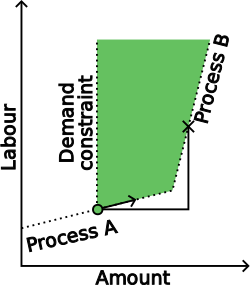
The slope of process A is one unit of labour per four units of output. This is the shadow price of that commodity at current demand. The effect of a small change in demand is illustrated using the arrow that points along the process A constraint. We can see that it is only accurate up to the point where process B must be used. There the shadow price changes abruptly to four units of labour per unit of output. A large/discrete change in demand is illustated using the line that ends in a cross. Arriving at that cross involves a full LP solve. The shadow price at A is useful because it allows for somewhat "decentralized" control. But said price only works for small changes in the economy. For large changes a costly LP solve must be performed.
Moving on, the notion that Capital's objective function can be "reverse engineered" from values seems novel. We can go even further: I suspect that any given price vector tells us the direction that Capital is trying to "push" labour at that moment.
This also marks my final departure from David Harvey's way of thinking about Capital. In Harvey's thought, value is labour. I held this view for a long time, which is equivalent to the mass labour theory of value, because I watched his lectures when reading Capital. While labour and value both have dimensions of person-time, they are not equal, much like yards and meters are not equal despite having dimensions of length.
Recovering the classical theories from the new theory
I said previously that we can reconcile what Marx says in Capital about the two value theories. I will now explain how.
The situation that Marx describes in vol I is equivalent to one where all production methods are sufficiently similar that the "average" production method is the same as the worst one. If at the same time all of those production methods output exactly one commodity then we have the result from vol I. All values are non-negative and they all add up to precisely the amount of labour added. Under such conditions we can say that value is labour, as Harvey does.
The above conditions are very restrictive and do not happen in practice. Let us relax them and see what happens.
Let us first relax the "averageness" condition. All methods still produce exactly one commodity, but for each commodity there are many different production methods with different productivities. In this case we can recover marginal values (ground rent and superprofit). Per-commodity values increase as demand increases. I describe the mechanism behind this in the post Agreement and disagreement with Robin Hahnel.
We can recover both theories at the same time whenever there's one and only one optimal point in the linear program, and that point only contains simple production methods. For those groups of production methods that are sufficiently similar to each other we recover vol I values. For all others we get vol III values. That is, value coinciding with labour is equivalent to uniformity in production methods!
Let be a production matrix ála Cottrell, with exactly one positive value in each column, that value being one. Let also be "sorted", so that all ones are either on the same row as the one in the previous column, or one row below it (a downward-sloping skyline). Finally, let all rows of contain one or more ones. In other words, a matrix that looks something like the following:
where denotes coefficients that are non-positive. We can formally define uniformity of production in some subset , like so:
In other words, is uniform if and only if all columns of P are equal. It should be easy to see that all columns of are equal to the average of the columns, because all columns are equal. We can then merge those columns, and all other subsets of columns that are identical to one another. If after doing this we arrive at a Leontief matrix obeying the Hawkins–Simon condition then we will have mass values.
Finally, if we relax the simple production condition then we will finally have a coherent theory of value. Instead we allow production methods to have any number of outputs, from zero to . In this case the value of a commodity is that commodity's shadow price(s). Each shadow price can be positive, zero or negative. Assuming feasibility, there can be either exactly one shadow price for a commodity, or a "spectrum" of them. Formally, there exists an extreme polytope that contains a set of feasible shadow prices, similar to what Wright says. This polytope can be a single point, in which case there is a single unique vector of shadow prices. This is a standard result from LP theory.
We no longer have equivalence between labour and values. But we can can use Novozhilov's to enforce equivalence, similar to what Marx does when transforming values to prices in vol III:
Value and labour both have dimensions of person-time. Therefore is dimensionless, and tells us how much value is produced per hour worked. In vol I we have as Harvey says. When the assumptions in vol I do not hold, which in reality is always, can no longer be assumed to be one. It can be greater than one, less than one, or even negative.
If we have two industries, A and B, and A produces 2 hours of value per hour worked, and B 1 hour per hour, and both are activated for one hour, then the total value is 3 hours from 2 hours of labour, and we have . If we divide both values by then we get 4/3 and 2/3 hours of labour, which shows how 1/3 hours of labour flows from B to A, precisely how Marx describes in vol III about rentiers parasitizing industrial capitalists.
Without it would become possible to create value out of thin air whenever marginal production takes place. With we see that profitability, and the exploitation of social labour, in uniform industries is depressed by marginality in other industries when . There is no 1:1 correspondence between labour and value. Value is a "rubber band".
We can use Novozhilov's minimum profit rate to separate surplus value into two parts: minimum profit and extra profit. Minimum profit is positive in capitalism. This contrasts with Marx's separation of surplus into mass profit and extra profit, which is based on the assumptions made in vol I, which we know to be false.
Finally, this new theory also explains slavery. In vol III Marx claims that slaves produce no value. This puzzled me for a long time, since surely there would be no point to slavery if it did not produce value. But from this new LP formulation that problem goes away. The revenue that slavers extract from their slaves is a purely marginal thing. It is realized relative to capitalists that employ salaried agricultural workers, and relative to landlords that extract ground rent. For the slaver the slave, once paid for, is gratis labour power. It is the cheapening of one of the slaver's means of production. This cheapening amortizes the longer the slave lives, the same way the cost of a new expensive machine amortizes the longer the machine lives. We have a curious case of surplus value being realized from constant capital alone.
Investment as an extension to the theory
In what I have said above I have assumed that the technical makeup of the economy is fixed. This means that values are always marginal. This is the same as saying that economics of scale do not exist. But as soon as we allow investment, the convexity that lies at the heart of marginality goes away. Here I choose to define "investment" as any change to any production method, including the introduction or retirement of production methods. Any change to , be it changing its coefficients or changing its dimensions.
When we move from linear programming to mixed integer programming we have a system where marginality and economics of scale can coexist. This ties into a lot of what Novozhilov says, since he was concerned with methods of pricing investments. Novozhilov was likely not aware of more systematic ways of solving MIP such as branch-and-bound, but some of his ideas come very close.
This also means that the total approach to computing values must also extend to investment. Without centralization, correctly pricing investments is impossible. How for example are we to decide whether to invest steel into rail, or into equipment for more steel plants? Rail transport depends on steel, but steel plants require rail for transporting ore and finished products. A suboptimal combination of investments will delay the development of both rail transport and steel production. Hence the need for centralized investment. Similarly with energy, we cannot allow the energy sector to decide its investments in isolation from other sectors, since an incorrect set of investments in energy can have catastrophic effects on the entire planet's economy and ecology.
Just like shadow prices emerge from convex planning and are at the same time useless for planning, so too it is with valuing/pricing investments. The means of correctly pricing investments is the same means by which said investments are planned! Without centralization, investments must be priced in terms of shadow prices. Why is this a problem? It is a problem because the shadow prices are changed by the investments!
There are some theoretical complications inherent in investment, such as the total cost of any worthwhile investment being negative. I may explore these in a future text. I will also note here that the standard interpretation of dual variables as shadow prices and as derivatives do not apply to integer constraints. Investments cannot be valued in isolation, only as "bundles", because investments are discrete and non-convex.
The necessity of negative values
Many Marxists insist on the positivity of value, or their non-negativity. But present material conditions show why value can not only be negative, but must be negative for some commodities.
I will first say that Capital abhors negative value. Capital doesn't want to produce commodities that it has to pay to get rid of. Hence the tendency towards dumping, be it industrial waste or carbon dioxide.
I make the case for negative values on two grounds: mathematical and normative.
From the mathematical point of view, a negative value is equivalent to an upper bound being active. In linear programming, shadow prices correspond precisely to the activity of primal constraints. Let us formulate our primal like this, because it is popular in practice:
Here is a vector of lower bounds and is a vector of upper bounds. We can formulate open bounds by inserting in and in in the appropriate places.
The sign of each shadow price is the opposite to the sign of the corresponding primal constraint. If a lower bound is active, then the shadow price is positive. If an upper bound, negative. If in a particular row neither bound is active, then the value of that commodity is zero. Such a commodity is a mud pie, even if said mud pie is in demand, because it is not in sufficient demand to activate a lower bound. This can happen for goods that are effectively a free byproduct of some production process, as Wright points out. It is not necessary for a commodity to be useless, or desired by no-one, for that commodity to be worthless. In places where water is clean and plentiful nobody charges for water. But in a desert, where water is not plentiful, and where it takes a lot of labour to transport water, we expect water to be costly.
Some readers may object to zero or negative values on the grounds that Marx says nothing like this. But Marx was not a mathematician. Marx struggled with calculus. Moreover, the necessary math did not exist in Marx' time. I don't think we can fault Marx for not performing feats of inhuman intelligence to produce the necessary math 70 years before Kantorovich and Dantzig!
Some readers might argue that negative values don't "exist", despite negative prices existing. Perhaps they don't. But I also don't really care, because I am making a normative statement here, not a descriptive one. To say that negative values are nonsensical is to take the side of Capital. It is to ignore the fact that sooner or later dumping has to be dealt with. The unfettered release of carbon dioxide into the atmosphere induces the labour required to sequester it. To deny the negative value of carbon dioxide emissions is to say that we should not sequester it. That we should leave the environment to chance. It is to assert that there are only goods, and no bads.
Metaphysics
In this text I have used quotation marks around the word "embody". The reason for this is because we now know that value is not "transferred" from inputs to outputs, since such "transference" imply mass values. The notion that commodities "embody" such-and-such amounts of labour is revealed to be mysticism in Marx. While Marx successfully turned Hegel right side up, he did not succeed in placing him on the ground.
Readers who disagree with me are free to design some apparatus with which to measure the amount of labour supposedly embodied in say the nearest sheet of paper. I am confident that they will fail in this endeavour, because it is not possible to measure something that does not exist. What we can measure is the amount of labour spent in the process that made that paper. But because of the imputation problem we cannot say where that labour "goes", because paper mills produce more things than just paper, such as electricity, heat and black liquor.
The above also implies that notions of value being "created" or "injected" must also be mystical. There's nothing "magical" about labour other than it being the most central input, the only thing that is the direct input to every labour process. What workers create is not surplus "value", but surplus products. These products have prices and shadow prices associated with them, and these prices are constantly in flux. Profit originates from the sale of the surplus products at whatever prices can be hung on them at that moment, which we expect to converge to the shadow prices of said products. Failing to see this amounts to mixing up prices, flows and stocks.
Because commodities do not "embody" value, value is not embodied in stocks of commodities either. This is the essence of the "valuation controversies" elaborated by Ellerman (see In-kind accounting). Any attempt at "valuing" commodities must credit an increase in the value of existing stock to some account. A decrease of the value of the stock must similarly be debited to some account. Such a process may please the bean-counters, but it is entirely unnecessary when the value of existing stock can be expressed as the scalar product between the value/shadow price vector and the quantity vector, and accepting that this number is always changing. The ground truth is the real physical stock, not the value/price of that stock. The bean-counters should count the beans, not the value of the beans.
We must also confront the supposed lower value-creating capacity of cheap/low value labour power, such as slaves and Third World workers. The reason why low value labour power appears to "create" less value is because it is cheap. When labour is cheap, there is no harm in using it even if it generates less product and less profit per hour worked, so long as the rate of profit is sufficiently high. Keeping the rate of profit high requires keeping the organic composition of capital low. This is typically done by using cheaper, less productive machines. As a result, low value labour power ends up underexploited. Underexploitation goes hand in hand with the underdevelopment of the means of production. The underdevelopment of the means of production is a fetter on the full exploitation of labour power.
Implications for pen-and-paper planning
One implication of all of the above is that GOSPLAN right from the start could have computed values via a process very similar to material balance planning. If you're navigating the primal as MBP does, you might as well navigate the dual too. As far as I can tell this was never done, likely because the necessary mathematics for this insight did not exist in the 1920's.
Note that the use of marginal values in production does not necessarily mean these values must be used in consumption. We can decide politically what constitutes needs, and price goods accordingly, including giving consumers certain things for free, up to some upper bound. People who consume meat beyond their ration will pay marginal prices, since this is meat in excess of their need. Such a scheme might have prevented the tragedy of the Novocherkassk killings, triggered by raising the price of meat and other goods to their shadow prices. Alternatively, the vegan vanguard is right to shoot carnists who disobey orders by consuming meat in excess of their allotment (zero).
Similarly, kolkhozniks do not need tons of bread with which to feed their pigs. Marginal prices on bread in production would prevent such irrational use of resources.
On the computational powers of Capital
If shadow prices are values then we also have a convenient theory for explaining why prices do not equal values. Solving a linear program exactly is a combinatorial problem. We can observe that Capital does not assign prices to values. Instead prices oscillate around some vector of values.
If Capital were able to price things perfectly then this implies that Capital has hypercomputational powers. This is not the case. No collection of humans can perform hypercomputation. Instead what is happening is that Capital is attempting to navigate a kind of mathematical optimization problem. Capital wants to make as much profit as possible, and constantly adjusts prices and quantities in an effort to achieve this. These numbers are ultimately bounded by real constraints, both physical and political. We find in practice that Capital often oversteps its bounds, even those it itself considers important. For example, it starts wars that sometimes lead to revolution. Were Capital capable of hypercomputation then such things would never happen.
This opens up the possibility of doing better than Capital. Capital runs around like a headless chicken, running blindly in any direction where profit currently exists, bumping into constraints along the way. There is no finesse in what Capital is doing. No forethought. The reason for this is because Capital lacks a "head". The market runs entirely on feedback, on local control. Therefore it is incapable of effecting good regulation. Planning can therefore be seen as cephalizing the human collective.
On the falseness of vertical integration
The concept of "vertical integration" is that we can "add up" labour added in each production step to arrive at values for all commodities. That is, that we can compute mass values. I have written on this before, in the post On vertical integration. I was wrong. It is not possible to vertically integrate labour to arrive at values. Similarly it is not possible to vertically integrate anything else, for example energy, to arrive at some kind of "embodied" energy (emergy).
The "vertical integration" of say carbon dioxide implies a change in the objective function. To compute "embodied" carbon we must change the objective function to carbon minimization instead of labour minimization. There is a mapping between extreme polytopes (shadow price sets) and objective functions, and we cannot guarantee that a change in the objective function doesn't affect the allocation of labour except in the extremely constrained case where all production is simple and uniform, as Marx falsely assumes in vol I. Only in the case where the feasible polytope is a single vertex can vertical integration be done, because this vertex is the extreme point in all directions.
The following diagrams explain the concept geometrically. First we have the case of a polytope with non-zero volume.
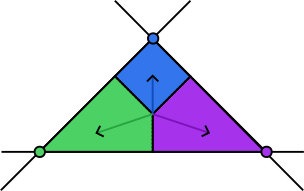
Each position in this polytope corresponds to a different set of labour allocations in industry. Three extreme (optimal) points are marked with circles. They correspond to three sets of objective functions – three sets of vectors that point in the general direction of each of those three points. If 0° is up then the blue area corresponds to objective functions with an angle between, but not including, -45° and +45°. Violet is +45° to +180° and green is -45° to -180°, also non-inclusive. There are also three objective functions (-45°, +45° and +180°) that are perpendicular to each of the constraints. We have six sets of objective functions in total, completing the circle. Each of these objective functions have a corresponding dual polytope which I will not attempt to draw into the diagram because drawing five-dimensional things is hard.
Each of the three extreme points, and the three sides, "touch" corresponding sets of dual solution(s). They do this because the strong duality theorem states that the duality gap is zero. We can sometimes change the objective function, but not too much, and retain the same optimal allocation of labour. When we make such a change then we will attain a different set of shadow prices without affecting the allocation of labour. Unfortunately this is not possible in general. If we wish to compute "embodied" carbon then we must change the objective function, and such a change may change the allocation of labour, meaning that the arrived at carbon values correspond to entirely different production activities.
Next we look at the case where the volume of the feasible set is zero. To make things coherent with vol I, the number and types of constraints is reduced to two equalities rather than three inequalities.
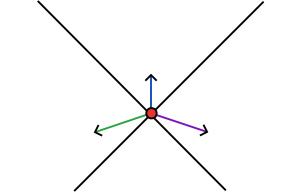
Here the extreme point for all objective functions is marked with a red circle. Optimal labour allocation is independent of objective function, because the feasible set is a single vertex. The dual to this system does change when the objective function changes, so that we get a different vector of shadow prices corresponding to each objective function. This is the situation vol I finds itself in, because production is uniform, and there is a one-to-one mapping between each commodity and each production method. This results in a square system, which is invertible, and this inverse corresponds to vertical integration. Unfortunately, real economies feature joint production, so this situation never happens.
Another way to look at the above described property is to consider what happens when one changes from minimizing some objective function to maximizing it. In the case where the feasible set is just a single point, then we get the same values, just with all the signs flipped. When the feasible set has non-zero volume then we are guaranteed to end up with a different set of labour allocations, and the shadow prices are not longer guaranteed to just be sign flipped.
A consequence of the impossibility of vertical integration is that it dooms all schemes based around Marxian labour vouchers. Such schemes face serious reproduction problems due to the existence of marginal production methods, especially if profit is to somehow be abolished. Such abolition implies soft budget constraints, which Kornai has criticized in many texts, for example "The Soft Budget Constraint" (KYKLOS, Vol. 39, 1986, Fasc. 1, pp. 3-30). Problems that Kornai identify with soft budget constraints include:
- runaway demand for inputs
- chronic shortages
- insensitivity to price changes
- breakdown of fiscal discipline inside firms
On the objective function
A change in the objective function carries profound political implications, and should not be done carelessly. At present Capital optimizes on social labour. But what is "social labour"? It is whatever labour Capital considers "valuable".
Social labour is not concrete labour. This we know from Marx. It is also not some kind of "average" labour. The value of labour power is not uniform, as Marx points out in vol III. Not within nations, not between nations.
The value of labour power is tightly coupled to the level of development of any given nation. This has been shown by Farjoun et. al. in "How Labor Powers the Global Economy". The wage rate tends to sit around 50% regardless of location or era. Capital cannot help but find that as the means of production develop, so too do workers' demands. Capital is thereby compelled to invest in yet more means of production so as to economize on the labour power whose value has risen as a result of previous investments!
The reverse of the above is that Capital squanders labour power in underdeveloped parts of the world. Personally I believe we should seek to level the value of labour power by bringing all parts of the planet to the same level of development, so as to bring an end to this squandering. This cannot be done by the stroke of a pen, or by pushing a button, but is a process that will likely take decades.
Language
One final concern is what names to put on things. I have used the term "value" above, but this has the problem of potentially causing confusion, since the term is so laden with historical meaning. One approach, taken by Dave Zachariah, is to avoid the term "value" entirely, and only speak of shadow prices. Normally I'd probably be too much of a troll to do this, since it's more fun to point out when people are wrong. But accurate language is more important, so perhaps a better approach is to just steer the conversation towards shadow prices whenever someone mentions "value", and to point out that "value" was a historical attempt at getting to the deeper truth of shadow prices.
For negative values, we could choose to assign other names to them. Novozhilov calls them "costs", and formulates his equations so that costs are always positive. This doesn't change the mathematics, but it serves a useful didactic purpose. We can extend this idea and introduce some useful language:
- an output is a "benefit" if it is sufficiently useful and doesn't activate any upper bounds
- an output is a "cost" if it does activate some upper bound
- an input is a "benefit" if it reduces pressure on one or more upper bounds
- an input is a "cost" if it does not reduce such pressure
For example, it is beneficial for a labour process to sequester carbon. The CO2 thus input has a negative cost since the sequestration process performs a social good.
The word "commodity" could also do with a similar treatment. I'm partial to the word "product", which is also distinct from the free gifts of nature.
Conclusions
I find that Marx has at least two mutually exclusive theories of value. Marx attempts to unite them in his chapters on revenue, but fails to explain why some industries are subject to marginal effects and others aren't. When mentioning superprofit, Marx makes it clear that marginal effects are not limited to agriculture.
A value theory based around linear programming, where values are understood to be shadow prices, and where the objective function minimizes social labour, neatly encapsulates both points Marx is trying to make. The "massness" versus "marginality" of values is directly tied to the differences in productivity of the production methods actually used. Where production methods are uniform, there exists an "average" production method, and value highly correlates with average labour. Where there are large differences in productivity, value becomes marginal.
Shadow prices are not unique. Therefore values are not unique. In some situations there can be a whole set of valid shadow prices. The shape spanned by those prices is a polytope.
Shadow prices can be negative. Such negative prices (values) correspond to an upper bound being active.
An LP based theory neatly deals with joint production. For each commodity one looks at the corresponding shadow price. The sign of this shadow price tells us which constraint, if any, is active. There is no problem at all dealing with the number of production methods not matching the number of commodities.
Total value does not equal total labour. This is apparent in vol III. We can make them equal by introducing a conversion factor .
Value is not labour, any more than a meter is a yard, even though the two share the same dimensions.
When changes are to be made to the economy, mixed integer programming can be used. MIP allows us to compute changes to total labour over time, but only for bundles of investments. In some cases bundles might be separable, but this is not true in general. Small changes to the economy can rely on shadow prices/marginal values, but big changes must rely on planning.
Vertical integration is not possible, and any scheme based on it is doomed to fail. This includes all schemes that take Gothakritik as their starting point. It is not difficult to come up with schemes that work under the restrictive assumptions of vol I. It is far more difficult to do so for real economies.
The theory presented here might not be what Capital is "actually" doing. This isn't much of a hindrance, because my ultimate point is that this is what we ought to do. We should price things using marginal labour values, because doing so ensures that we pay attention to the worst workplaces first. Marginal values ensure that such low-hanging fruit are picked first, either by directly investing in said workplaces, or by making investments that take said workplaces out of use.
Finally, the term "value" is probably best avoided going forward.